
September isn’t just for students breaking in new notebooks. It’s “back to school” season for working professionals too. As offices regain their rhythm, corporate travel calendars are back on the agenda.
While remote work and digital meetings have permanently shifted how we connect and business air travel has been on the decline across Europe, what does the latest data tell us? Has this trend been confirmed, or is flying seeing a rebound?
A key partner of the Travel Smart Campaign, Dutch environmental organisation Natuur & Milieu answers that exact question. Their latest research analyses 50 major companies operating in the Netherlands to reveal who is successfully cutting down on corporate travel emissions and who is lagging behind.
Who are the leaders and the laggards?
Port of Rotterdam (-62%), ABN AMRO (-59%) and IKEA (-61%) top the ranking, by combining substantial emission reductions with ambitious targets and relatively transparent reporting. As well as they reduced their business flight emissions by more than 50%.
Even more promising, most companies manage to sustain their reductions. From 2023 to 2025, eleven organisations cut emissions further, seven held onto their gains and only seven experienced a rebound.
Many of these companies that have significantly reduced their air travel are members of the Anders Reizen coalition for sustainable mobility.
At the bottom of the ranking are Danone, Unilever, ING Group and Shell plc. These companies provide limited transparency on their business travel emissions and lack policies to reduce them.
Clear targets mean effective results
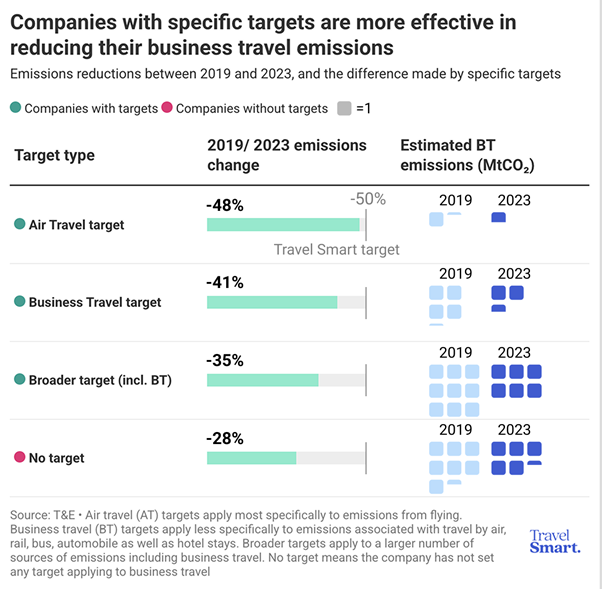
For the 29 companies for which a comparison between 2019 and 2025 was possible, the overall business flight emissions are on average 37.5% lower than before 2019. Of the 50 companies surveyed, almost half of the companies surveyed have a target, while the remaining 26 companies don’t report any target
In fact, companies with a clear business travel or air travel target achieved an average 43% reduction in emissions, compared with 35% for companies without such targets. This confirms what the Travel Smart Ranking has shown that more specific targets lead to more effective reductions.
Transparency is a key lever to achieve emissions reductions
For 19 of the 24 companies with a target (79 percent), it was possible to determine the emissions trend between 2019 and 2025. Among the companies without a target, this was possible for 10 of the 26 companies (38 percent).
Companies at the top of the list generally have consistent emissions data gathering, clear reporting and more frequently externally verified information. However, companies at the bottom of the ranking scoring low reflects not only limited progress but often also a lack of transparency regarding the reporting of corporate air travel emissions.
Therefore, targets appear to be associated not only with lower emission levels, but also with greater transparency and public accountability. Transparency is a key prerequisite for effective reduction policies. Only when aviation emissions are reported separately can it properly be tracked whether companies are actually flying less and how emissions are changing over time.
All sectors gather leaders and laggards
Interestingly, cutting emissions isn’t a one-and-done deal. Since 2023, a lot of companies, particularly consulting firms, have seen their progress stall or reverse. What really stands out is that you’ll find climate leaders and laggards in almost every sector. This suggests that business travel emissions are driven more by the choices companies make than by the nature of their activities or business model.
ICT, Telecom & Technology, Finance and Consulting are, on average, among the top-performing sectors. These sectors have a relatively large number of companies with substantial emissions reductions, clear targets and high scores. It is notable that all consulting firms are still below their 2019 levels. But at the same time, consulting is the sector showing the clearest rebound. EY, Accenture, Deloitte and PwC all report higher emissions than in 2023.
This demonstrates that significant reductions are possible and that lasting reductions require continuous management and oversight. Furthermore, consulting firms are among the largest emitters in the ranking, meaning that reductions in this sector have a significant importance for the climate.
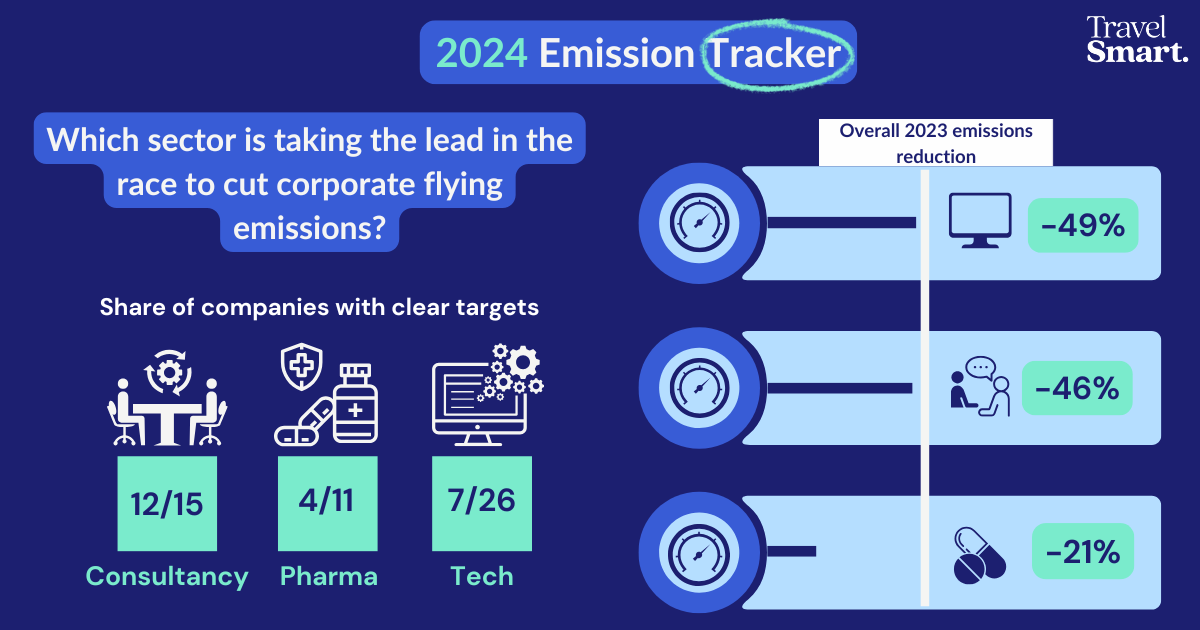
This aligns with three Travel Smart sectoral analyses examining who is winning and losing the race to cut corporate flying emissions across Consulting, Technology and Pharmaceuticals. Notably, major polluters can pull down their entire sector’s overall progress in cutting emissions. In 2023 this was the case for the pharmaceutical sector, which reduced its emissions by only -21%, compared with 2019 levels. The reduction could have been twice as much at -44%, if Johnson & Johnson and Merck had reduced their emissions by half. Instead, Johnson & Johnson only reduced them by 10% and Merck increased them by 29%.
In the Netherlands, Manufacturing, Retail and Construction are lagging behind. Companies in these sectors often don’t publish emissions data, and as a result, many companies in these sectors have low scores. Manufacturing, in particular, stands out due to the large number of companies for which available information is lacking to assess their business air travel emissions.
That is why Natuur & Milieu and Travel Smart are calling on laggards to follow the example set by the leading companies in their sectors. With clear targets, transparent monitoring and an active international travel policy, they too can significantly reduce their climate impact.
Flying less is the way to do business
Reducing flying remains one of the most direct ways to cut emissions now. Especially given the limited scalability of alternative aviation fuels and electric planes in the near term.
There are alternative ways to attend business meetings. Opt for using rail where possible. Travel Smart’s Rail First analysis has shown that a number of leading companies have developed rail policies to encourage employees to travel by train instead of by plane. Use virtual collaboration tools. Combine several meetings in order to avoid one-day trips. Or send a representative based close to where the meeting is held instead of from headquarters.
Many organisations learned that business can be conducted successfully with significantly less flying and are continuing to unlock the benefits of doing so.
Responsibility, however, extends beyond the private sector. Governments must enforce robust corporate emission reporting, following the lead of countries like Spain, France, and the Netherlands.
With the recent heatwaves, fires and drought, it is now more than ever, imperative to make rapid and sustained emissions reductions. Business air travel is one of the quickest and easiest ways to do so. And it can provide momentum in rethinking our way of traveling and in shifting our mobility habits.
Aiza Rodrigues Akhtar, Aviation Campaign Officer