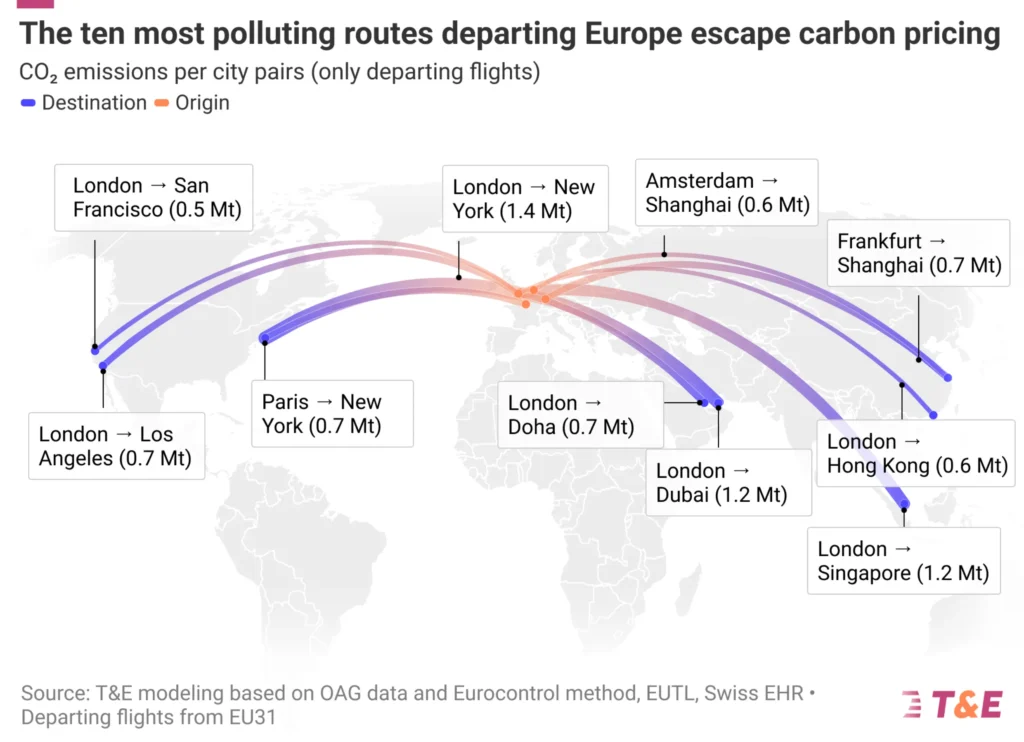
In 2025, the most polluting flights departing from Europe were all long-haul flights, such as the London-New York or Frankfurt-Shanghai routes.
The London–New York route is the single most polluting departure route, emitting nearly 1.4 million tonnes of CO₂ across all departing flights. That’s roughly equivalent to the annual emissions from all petrol and diesel cars in a city the size of Munich.
Most of the other top-emitting routes also originate in London, reflecting the scale of long-haul traffic passing through UK airports—particularly London Heathrow. And these flights aren’t taxed at all.
Long-haul flights not only emit CO2 emissions but also produce additional emissions: the most visible of these take the form of contrails, long cloudy strips. Also called “non-CO2 emissions”, they they warm the climate at least as much as much as do CO2 emissions. Avoiding a relatively small number of long-haul flights can thus have big benefits for the climate.
Taxing flights based on distance, as the Netherlands will introduce, can generate revenue that could be invested in green technologies like sustainable aviation fuels (especially e-kerosene) and zero-emission aircraft. Travellers should avoid unnecessary long-haul flights and prioritise destinations accessible by rail or other low-emissions transport.